

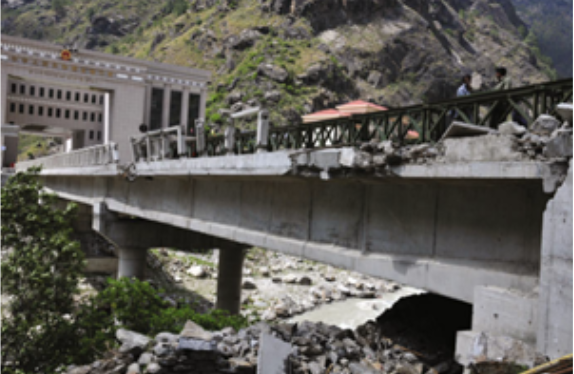
Rural accessibility is essential for the social and economic development of remote regions around the world. Issues with providing accessibility in Low Income Countries is exacerbated in Nepal, where the mountainous terrain and 6,000 rivers (Dhungel, 2009) make road building very challenging. In addition to this, the 7.8 magnitude earthquake in 2015 damaged many bridges (Figure 1), although very few collapsed completely (Quancai et al, 2017). The Local Roads Network (LRN) in Nepal stands at 50,943 km, of which only 16,177 km is functional (Pande, 2014) and only about 9,000 km is in an all-season condition due to lack of maintenance and inadequate river crossings. It is maintained by the Department of Local Infrastructure (DoLI). Bridges are a key factor in developing an all-season road network. In Nepal approximately 40 bridges are under construction on the LRN (DoLI, 2019), but it was estimated in 2012 that a further 3,500 are required to make the LRN motorable and accessible throughout the year (Pande, 2014). Presently most bridges on the LRN are constructed of reinforced concrete, cast-in-situ. The quality of construction is highly dependent on the availability of suitable sand and aggregate in the vicinity of the bridge site. Transportation time for reinforcement and cement and the capacity of the available contractors also determine the speed and quality at which bridges can be constructed (IPTM Nepal, 2015). This has been a long-term cause of concern for the Nepal government. To address this huge demand for bridges in remote locations, different technologies and approaches need to be explored. This motivated UKaid to fund a project under the Research for Community Access Partnership (ReCAP) in 2016. Following a project workshop with key stakeholders in Nepal in January 2017 it was agreed that a modular bridge system would be appropriate, if the module size and weight could be limited to facilitate transportation to remote locations. A maximum module weight of 3 tonnes was agreed, with the length determined accordingly given the standard cross section and design of the module. Such technology is available in more developed countries but would need to be adapted for use in Nepal, and importantly would need to be designed to resist earthquake damage.
External article at The future of Transport